Description
Pine Wood (Pinus sylvestris) – Poland
The primary distribution of commercially utilized pine in Poland and Central Europe is Pinus sylvestris. This species is widely found across Northern and Central Europe and represents one of the most important softwood resources in Poland. Scots pine forests cover a large portion of Polish forest areas, making it a key raw material for the timber industry. Pine trees typically reach heights of 30–40 meters with trunk diameters ranging from 0.6 to 1.2 meters, though larger specimens may occur under favorable growing conditions.
Application of Pine
Large diameter pine logs are commonly used in the sawmilling and construction industries. Pine lumber is widely utilized for structural timber, pallets, packaging materials, furniture, interior joinery, flooring, and panel production. Due to its good impregnation properties, pine is also frequently used for outdoor applications such as fencing, garden furniture, cladding, and decking after preservative treatment. Pine is also an important raw material for wood pellets, briquettes, and pulp production.
Characteristics of Pine
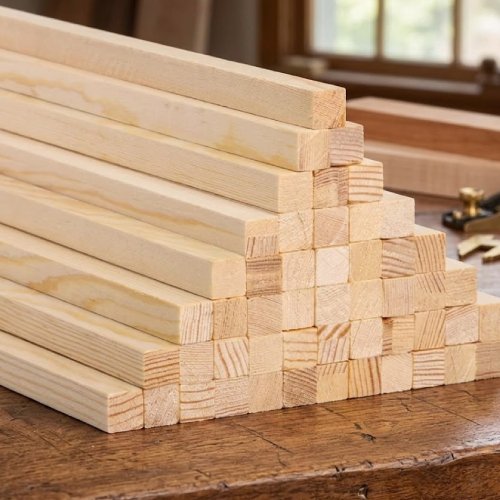
The heartwood color ranges from light reddish-brown to yellowish-brown, while the sapwood is typically pale yellow to nearly white and usually clearly distinguishable from the heartwood. Pine wood has a straight grain and medium to coarse texture with visible growth rings. Resin canals are often present, which is characteristic of pine species.
The wood is easy to work with both hand and machine tools, offering good results in sawing, planing, and finishing. Pine glues, nails, and screws well. However, due to its relatively low natural durability, pine wood is generally treated with preservatives when used outdoors.
Pine exhibits moderate shrinkage, providing fair dimensional stability when properly dried. Resin content may occasionally cause surface staining or pitch pockets.
Technical Properties
Gross density (12–15% MC): 400 – 520 – 650 kg/m³
Compressive strength: 35 – 45 – 55 N/mm²
Bending strength: 65 – 85 – 100 N/mm²